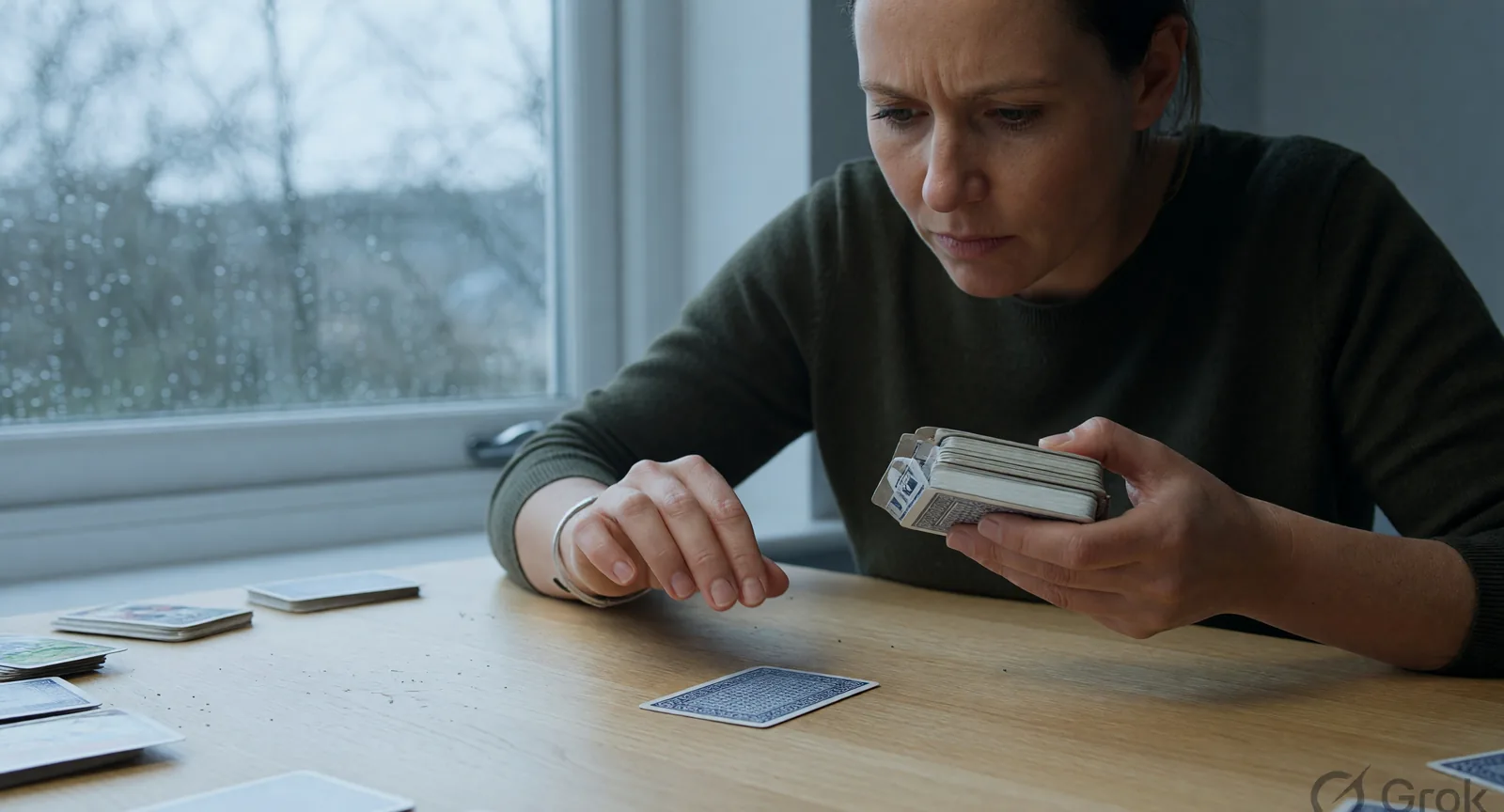
Deadwood climbs, then an invalid declare, then the table loss
First the ungrouped cards get heavier. Then someone declares without a pure sequence. Then the table applies whatever penalty the live print names. That three-step downside is the reason these boundary notes exist. Tips that skip the downside are advertisements.
Skill on a casinobet rummy seat, as this desk uses the word, means legal choices you can defend: which discard to publish, whether a declare meets the test, whether Points or Pool matches your clock. Chance is the next closed card and every hidden opponent card.
Signal you can name, noise you cannot
A discard is a public fact. You can remember it. That memory is skill. The next card from the closed stock is not a fact until it is turned. Treating it as due is noise.
Opponent body language, chat taunts and last-hand stories are noise. They do not change the printed declaration test. If a live table has no chat, you have lost nothing relevant to the test.
A 14-point legal hand versus an invalid clean pile
Hand L: one pure sequence, one second sequence, a set, and leftover cards that would score 14 on common point talk. If the live table accepts that shape, Hand L is legal. The 14 is a cost, not a failure of the rule test.
Hand I: tidy groups that look complete and a joker standing inside every sequence. On common conventions Hand I fails because no sequence is pure. The pile can look cleaner than Hand L and still be illegal.
If you raise after seeing tidy groups across the table, you are paying for an appearance. Appearances are not the test.
Cause: the closed deck stays closed
You cannot skill your way into knowing the next stock card. Any sentence that says otherwise is selling certainty. This desk will not sell it.
You can skill your way into not declaring Hand I. You can skill your way into discarding a card that does not finish a sequence you still need. Those are responses to information you already have.
Impact at the cashier is still unknown here
This desk does not print casinobet stakes. The impact of an invalid declare is therefore described as a table loss in the live print, not as a rupee figure. If the live screen names a penalty, that name belongs there.
Response: stop lists, not slogans
Before a raise, name the pure sequence you hold. If you cannot name it, you have no raise thesis. Before a Pool seat, name the clock you will keep if someone else busts. If you cannot name it, you have no Pool thesis.
Read the boundary notes again if a friend describes a sure pickup. Then open responsible play and set a stop that does not care about the next card.
What a raise cannot fix
It cannot create a pure sequence. It cannot shorten a printed 201 line. It cannot make a closed card known. If those sentences feel obvious, keep them anyway. Most table damage starts when they stop feeling obvious.
Where skill ends and responsible play begins
Skill chooses among legal actions. Responsible play chooses whether to take another action at all. Mixing the two produces slogans like playing smarter after a loss. That slogan is not a discard plan and not a limit.
When the downside sequence has already happened once tonight, the next task is the control workshop, not a new interpretation of the closed deck.
Worked discard, named and bounded
You hold two hearts that want a third, and a spare club that sits in no group. The public discard is a heart you need. Taking it is a named reason. Discarding the spare club is the usual follow. If that club would have completed a visible opponent sequence, you still discard it if it does no work in your hand. You cannot hold every card that might help someone else.
That paragraph is a legal choice under common conventions. It is not a winning line. The next stock card can still be useless. Say that out loud before you treat the pickup as skill.
What would change this judgment
A live casinobet print that allows a joker inside the required pure sequence would change the invalid-hand example. A live print that scores deadwood differently would change the 14-point talk. Until that print is cited here, the examples stay labeled as common-table conventions.
Read the boundary notes, then set limits before another deal.
Open the control workshop or Open casinobet
A downside you can time on a clock
Minute 0: you sit with a deposit cap written down. Minute 12: deadwood is worse after two unlucky stocks. Minute 18: you declare because the timer is red and the piles look tidy. Minute 19: the declare is invalid because the only long run used a joker. Minute 20: the live print applies its penalty. That timeline is the problem these notes keep pointing at.
The cause is not bad luck in minute 12. The cause is using a timer and tidy piles as a substitute for the pure-sequence test. The impact is a table loss whose size this desk will not invent. The response is to discard and survive when the checklist fails.
Hidden hands stay hidden
You will not see opponent cards unless a live table prints a show rule after a declare. Until then, reading faces across the table is fiction. Do not build a raise on fiction.
You will see discards. That is the entire public record. Skill is remembering that record well enough to avoid feeding a sequence you have already watched being built. Skill is not predicting the stock.
Chance dressed as pattern
Three low stocks in a row do not make a high card due. Independent draws, if the live shoe is a closed deck, do not owe you a balance. Pattern talk is how people raise after a loss.
If you catch yourself saying due, stand up. That word is the cue for the control workshop, not for a larger stake.
A raise is a price, not a theory
A raise changes the cost of the same chance. It does not improve the chance. People raise after an invalid declare because they want the previous hand to have meant something. The previous hand already ended. Meaning is not a legal card.
If you write the raise reason and the reason is I was due, tear the paper. If the reason is I now have a named pure sequence and I am changing format, you have a different page to read: the format comparison.
Boundary notes end here: skill names public facts and legal tests. Chance names the closed deck and hidden hands. Responsible play names the stop. Keep the three words on separate lines.
Two notebooks, one rule
Keep a public notebook and a private notebook. The public notebook lists discards you have seen. The private notebook lists combinations you still need. Never copy a needed combination into chat. Never let the public notebook include guesses about hidden cards.
When the public notebook and the private notebook conflict, believe the public one. A card that has been discarded cannot complete your private run. Cross the run off. Do not wait for the deck to change its mind.
Close both notebooks when the session clock ends. A notebook that follows you into the next day becomes a grudge. Grudges raise stakes. They do not improve discards.
If you do not want paper at the table, use the same split in your head: public facts versus private plans. The split is the skill. The paper is only a tool.
Chance still owns the stock. The notebooks do not reduce that ownership. They only stop you from paying extra for a story.
Leave the closed deck unnamed
Do not give the next stock card a nickname. Nicknames turn chance into a character. Characters get sequels. Sequels get raises.
If you must name something, name the last public discard and the combination it blocked. That name is a fact.
Remaining questions
Is discard tracking skill?
Yes, in the narrow sense that you can remember public cards. It does not reveal the closed deck.
Does a raise change chance?
No. A raise changes how much a chance outcome costs. It does not change the next facedown card.
What is a 14-point example?
Fourteen points of ungrouped cards in an otherwise legal hand, on common point talk. It is not a casinobet stake.
Due is a banned word at this table
If you hear yourself say due, stand up. The stock does not owe you a balance. The notebook of public discards still exists. The closed deck still does not.